
ALI
JAMJAH.
Coordination chemistry, molecular architecture and photophysical phenomena. Exploring how subtle changes in molecular structure reveal entirely different properties of matter.
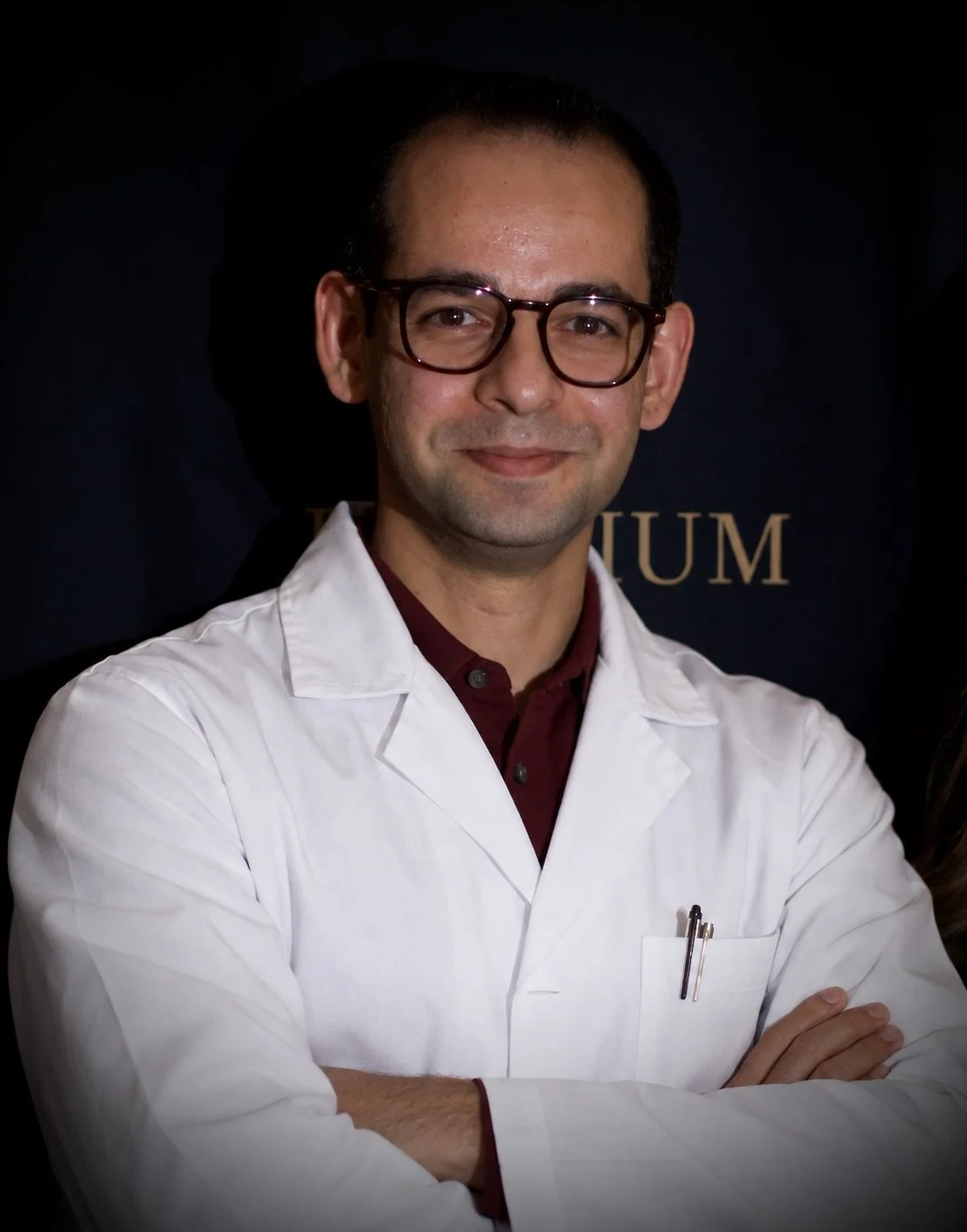
Beyond the
visible.
For Ali Jamjah, chemistry begins with a question: how can the smallest change in molecular architecture produce a completely different behaviour? His work explores the relationship between molecular coordination, electronic structure, supramolecular organisation and optical properties. From chromophores to crystalline assemblies, he studies matter at the point where structure becomes function.
His approach reflects a central idea at Helnium: understanding matter is just as important as revealing its beauty.
Structure shapes
everything.
An interactive, conceptual representation inspired by Ali's research into cyanine molecular systems. Drag the joystick to explore the structure.
Explore the
architecture.
Molecular orientation changes how we perceive a structure. Explore the arrangement from different angles.
DRAG TO ROTATE
Chemistry of
relationships.
Exploring the connection between chemical structure, molecular interactions and the physical properties that emerge.
Metal & ligand
chemistry.
Investigating how metal centres, ligands and coordination environments influence molecular geometry, stability and emergent properties.
Light & energy
transfer.
Studying cyanine chromophores, electronic excitation and ultrafast energy-transfer processes that connect molecular design with optical behaviour.
From molecules
to materials.
Understanding how intermolecular forces, crystalline packing and subtle chemical modifications affect the properties observed at larger scales.
Artistic representation of spectral behaviour. Curves are illustrative and do not reproduce measured data.
Science before
the image.
At Helnium, Ali brings the perspective of a coordination chemist: the ability to look beyond the visual result and investigate the chemistry responsible for it.
His understanding of molecular structure, ligand interactions, crystal formation and photophysical phenomena helps connect scientific interpretation with visual exploration.
This is where his research mindset meets Helnium's philosophy. The aim is not to impose beauty on matter, but to understand the conditions under which its own organisation becomes visible.
Not to exploit matter.
To reveal and understand it.