
HÉLÈNE
LAMBERT.
CHEMISTRY / CRYSTALLOGRAPHY
SCIENTIFIC DESIGN / FOUNDER OF HELNIUM
Hélène Lambert is a Swiss chemist and the founder of Helnium, a scientific design studio exploring the hidden visual language of matter. Her interests lie at the intersection of coordination chemistry, crystallography and non-equilibrium phenomena — where molecular interactions, changing conditions and self-organization give rise to unexpected structures.
EXPLORE HER UNIVERSE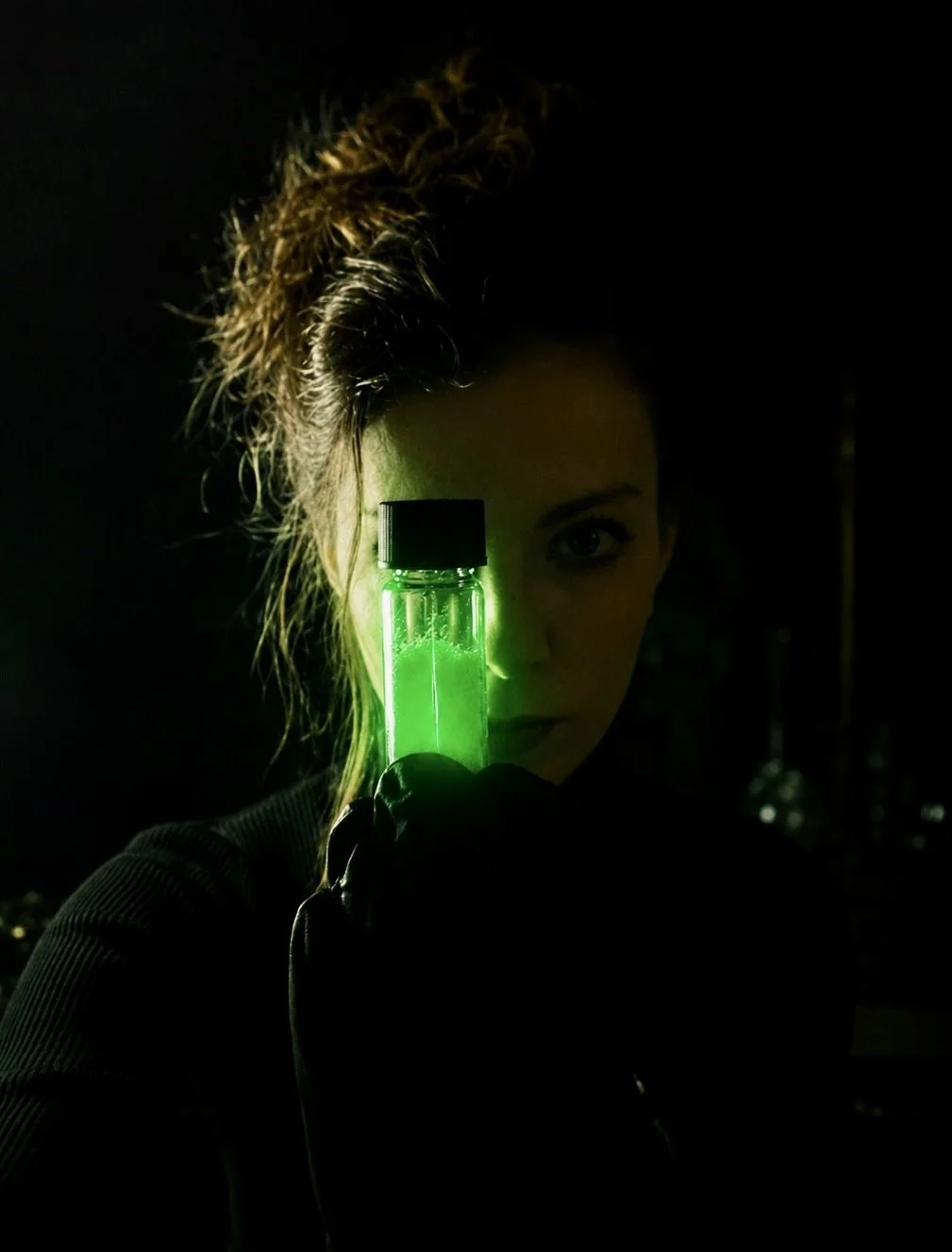
THE HIDDEN
LANGUAGE OF MATTER.
How does molecular organization become visible? Why do simple chemical systems generate intricate structures? And what happens when matter evolves far from equilibrium?
Hélène's scientific interests are rooted in chemistry, with a particular fascination for coordination compounds, crystal growth and the relationship between molecular structure and macroscopic form. Coordination chemistry reveals how metal centres and surrounding ligands can generate complex architectures, distinctive geometries and remarkable optical properties.Beyond equilibrium structures, she is drawn to systems in which evaporation, concentration gradients, transport and crystallization influence the emergence of patterns.
Her work through Helnium explores these processes experimentally and visually, using polarized-light microscopy to reveal the structures that develop as matter reorganizes.
Conceptual six-coordinate iron complex. Ligands are schematic, not a specific compound.
COORDINATION CHEMISTRY
Metal–ligand interactions, coordination geometries and molecular architectures.
CRYSTALLOGRAPHY
Symmetry, ordered structures and the relationship between composition and form.
NON-EQUILIBRIUM SYSTEMS
Pattern formation, crystal growth and self-organization under changing conditions.
ORDER EMERGES
FROM CHAOS.
Under changing conditions, chemical systems can produce structures that are far more intricate than their individual components suggest.
An artistic visualization inspired by self-organization and crystal-growth patterns. The slider morphs between two conceptual geometries; it does not calculate a physical thermodynamic trajectory.
Far-from-equilibrium systems are particularly fascinating because their evolution cannot always be understood by looking at the final state alone. Transport, local gradients, kinetic processes and interactions can influence which structures emerge.
Through controlled evaporation and crystallization experiments, Hélène explores how these conditions can produce dendrites, branching structures, geometric domains and complex microscopic landscapes.
WHEN CHEMISTRY
BECOMES ART.
Helnium was born from the conviction that matter does not need to be artificially decorated to become beautiful. Its own structure can be the artwork.
“The most beautiful patterns often appear when matter is allowed to organize itself.”
A dialogue between molecular science, light, geometry and artistic perception.
Using polarized-light microscopy, Hélène transforms experimental observations into photographic works, objects and visual identities. Every image begins with real matter: a molecule, a solution, a crystallization process and a particular set of experimental conditions. Rather than inventing the structures, Helnium seeks to reveal them — translating chemical phenomena into a visual language that can exist beyond the laboratory.
DISCOVER HELNIUM
THE GEOMETRY
OF MUSIC.
For Hélène, science and music are not separate worlds. Both reveal relationships, rhythm, structure and the emergence of complexity from simpler elements.
Piano has shaped the way Hélène perceives movement, harmony and form. In music, she recognizes patterns unfolding through time; in chemistry, she finds a similar fascination in the way matter evolves through space.
BETWEEN SCIENCE,
ART AND MATTER.
Hélène's approach brings together scientific curiosity and artistic sensitivity. Chemistry provides the material, experimentation reveals its behaviour, and light makes its hidden structures visible.
From the geometry of coordination compounds to patterns formed under changing conditions, she sees matter as an endless source of visual exploration.
THE WORK.
THE RECOGNITION.
A journey shaped by curiosity, scientific experimentation and the desire to reveal the beauty of matter beyond the laboratory.