Scientific Description : Crystallized Caffeine
This artwork presents needle-shaped crystals of pure caffeine, extracted in the laboratory from Glarner Kaffee coffee beans (Frauenfeld Roastery). Caffeine (C₈H₁₀N₄O₂), also known as 1,3,7-trimethylxanthine, is a naturally occurring purine alkaloid. In its pure form, it appears as a white crystalline powder. The molecule is highly planar and rigid, promoting directional molecular stacking during recrystallization. Within its monoclinic crystal system, growth occurs preferentially along a specific crystallographic axis, leading to the formation of the characteristic elongated needle-like structures. Under polarized light, these crystals exhibit strong birefringence. Their anisotropic structure splits light into two rays traveling at different velocities, producing interference colors when the rays recombine. This phenomenon generates the striking blue, violet, and golden hues visible in the artwork, despite caffeine itself being colorless under ordinary conditions. From a biological perspective, caffeine acts primarily as an antagonist of adenosine receptors, contributing to increased alertness, attention, and wakefulness.
Artistic Description
At first glance, these caffeine crystals resemble a dense forest of pine needles, as though an entire landscape had emerged at the microscopic scale. Each crystal grows along a precise direction, forming delicate bundles and intricate structures that evoke both the lightness of botanical forms and the rigor of mineral architecture. The material adopts a surprisingly organic visual language. Fan-shaped arrangements, branching motifs, and needle-like structures appear throughout the composition, creating forms that seem alive despite arising purely from molecular self-organization. Nothing here is biological—these patterns emerge solely from the geometry of the caffeine molecule and the way it crystallizes under controlled laboratory conditions. Under polarized light, the crystals become illuminated with vivid shades of blue, violet, and gold. These colors are not pigments or dyes; they originate from the crystal structure itself. Variations in refractive index and birefringence modify the propagation of light through the material, revealing the hidden architecture of the crystal lattice. What emerges is a sense of continuity between the molecular, mineral, and living worlds. Similar organizational principles, geometries, and growth patterns appear across vastly different scales of nature.
Product Features
Glossy black ceramic mug for vibrant, high-contrast artwork reproduction
Available in 11 oz and 15 oz sizes
Microwave and dishwasher safe for everyday use
Comfortable C-shaped handle
Lead-free, cadmium-free, and BPA-free
Features an original Helnium crystal artwork created from laboratory-grown caffeine crystals
Care Instructions
Scientific Description : Crystallized Caffeine
This artwork presents needle-shaped crystals of pure caffeine, extracted in the laboratory from Glarner Kaffee coffee beans (Frauenfeld Roastery). Caffeine (C₈H₁₀N₄O₂), also known as 1,3,7-trimethylxanthine, is a naturally occurring purine alkaloid. In its pure form, it appears as a white crystalline powder. The molecule is highly planar and rigid, promoting directional molecular stacking during recrystallization. Within its monoclinic crystal system, growth occurs preferentially along a specific crystallographic axis, leading to the formation of the characteristic elongated needle-like structures. Under polarized light, these crystals exhibit strong birefringence. Their anisotropic structure splits light into two rays traveling at different velocities, producing interference colors when the rays recombine. This phenomenon generates the striking blue, violet, and golden hues visible in the artwork, despite caffeine itself being colorless under ordinary conditions. From a biological perspective, caffeine acts primarily as an antagonist of adenosine receptors, contributing to increased alertness, attention, and wakefulness.
Artistic Description
At first glance, these caffeine crystals resemble a dense forest of pine needles, as though an entire landscape had emerged at the microscopic scale. Each crystal grows along a precise direction, forming delicate bundles and intricate structures that evoke both the lightness of botanical forms and the rigor of mineral architecture. The material adopts a surprisingly organic visual language. Fan-shaped arrangements, branching motifs, and needle-like structures appear throughout the composition, creating forms that seem alive despite arising purely from molecular self-organization. Nothing here is biological—these patterns emerge solely from the geometry of the caffeine molecule and the way it crystallizes under controlled laboratory conditions. Under polarized light, the crystals become illuminated with vivid shades of blue, violet, and gold. These colors are not pigments or dyes; they originate from the crystal structure itself. Variations in refractive index and birefringence modify the propagation of light through the material, revealing the hidden architecture of the crystal lattice. What emerges is a sense of continuity between the molecular, mineral, and living worlds. Similar organizational principles, geometries, and growth patterns appear across vastly different scales of nature.
Product Features
Glossy black ceramic mug for vibrant, high-contrast artwork reproduction
Available in 11 oz and 15 oz sizes
Microwave and dishwasher safe for everyday use
Comfortable C-shaped handle
Lead-free, cadmium-free, and BPA-free
Features an original Helnium crystal artwork created from laboratory-grown caffeine crystals
Care Instructions

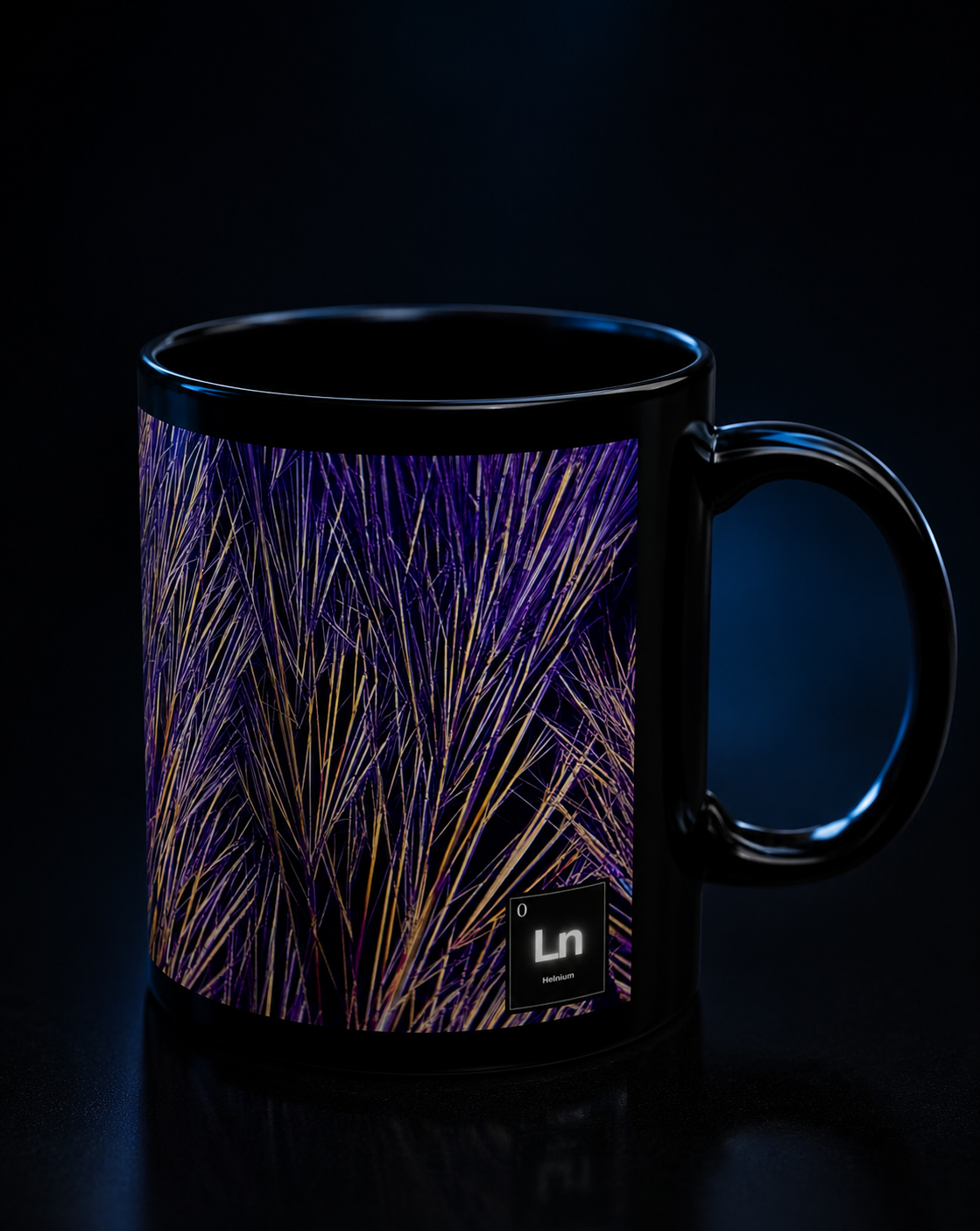 Image 1 of 9
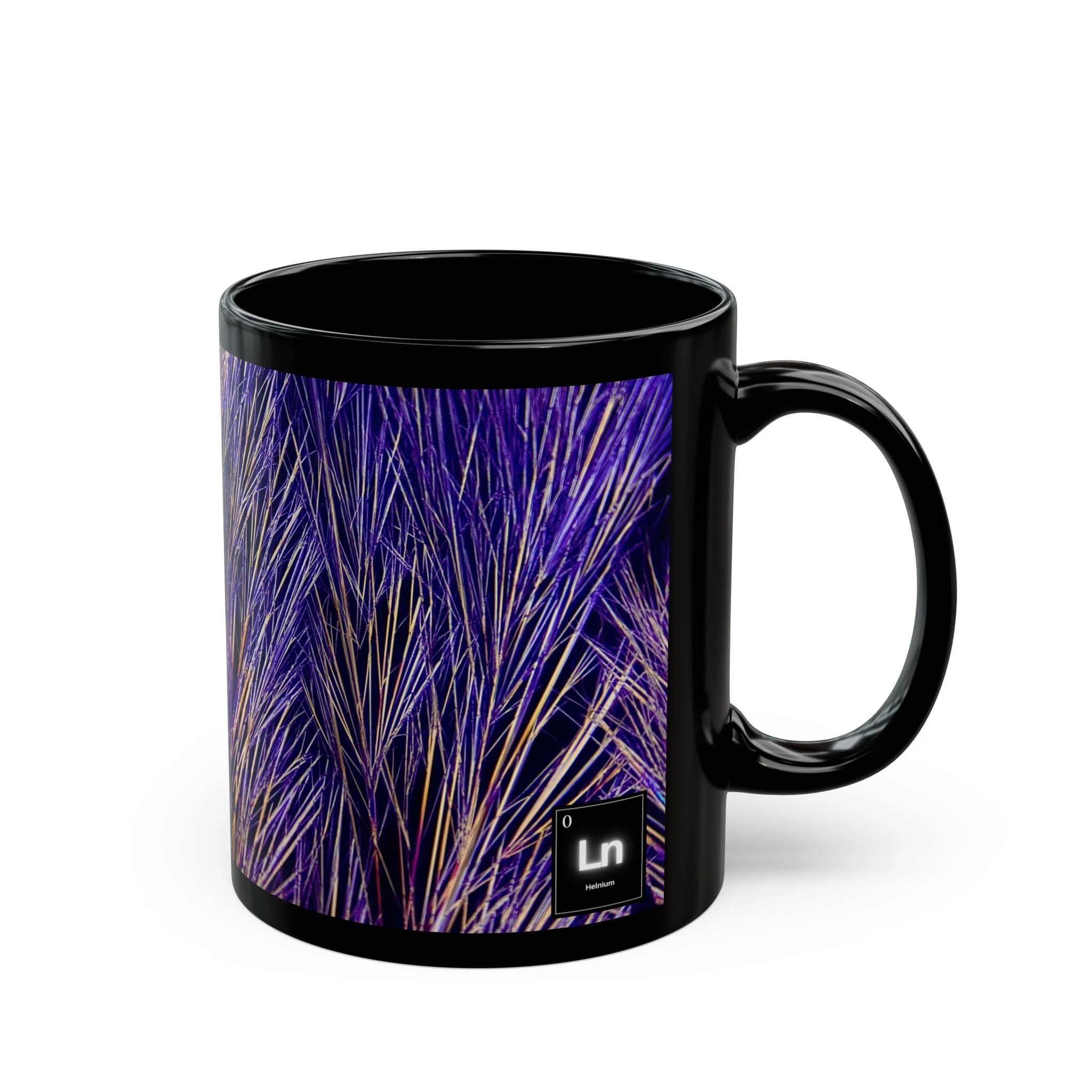 Image 2 of 9
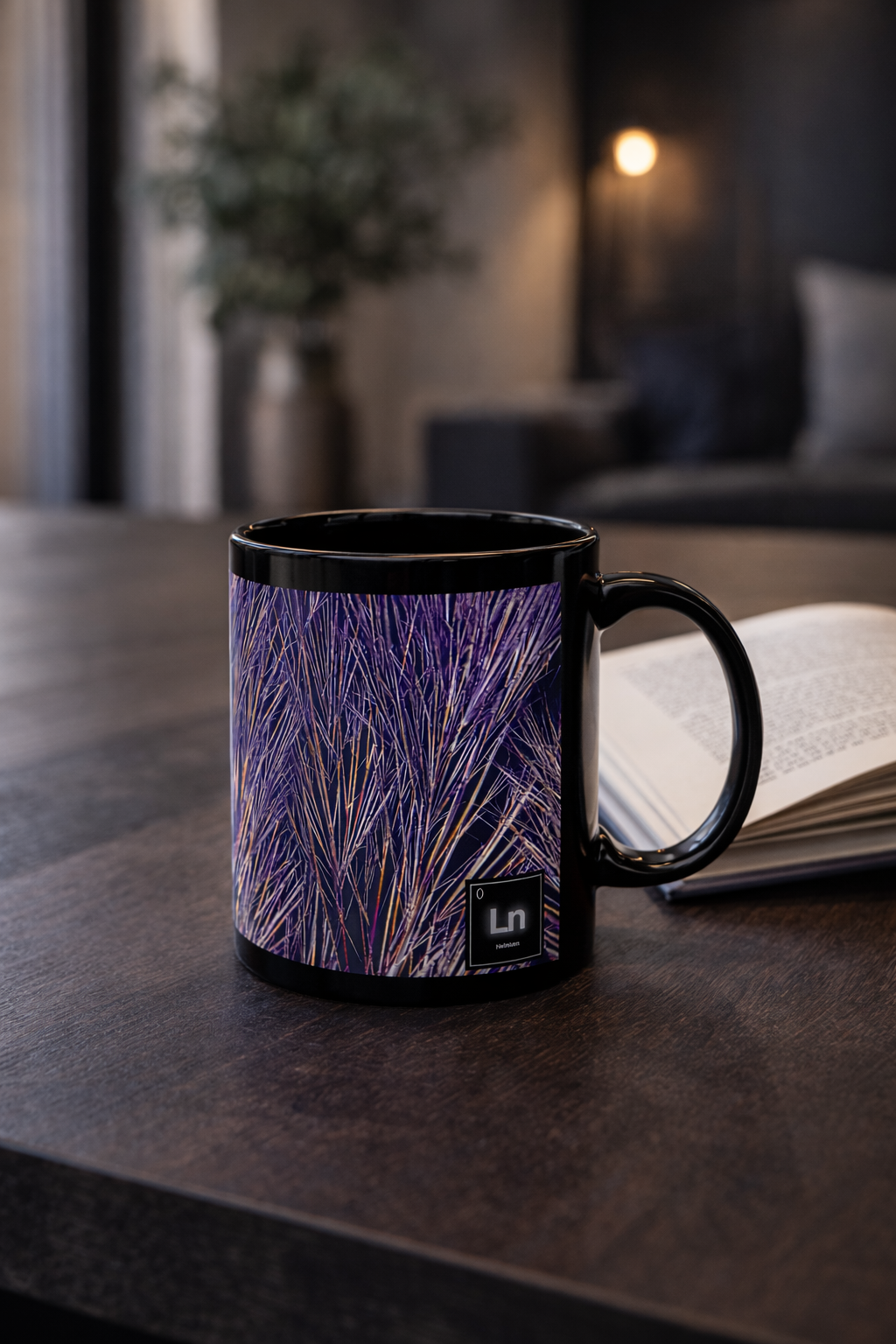 Image 3 of 9
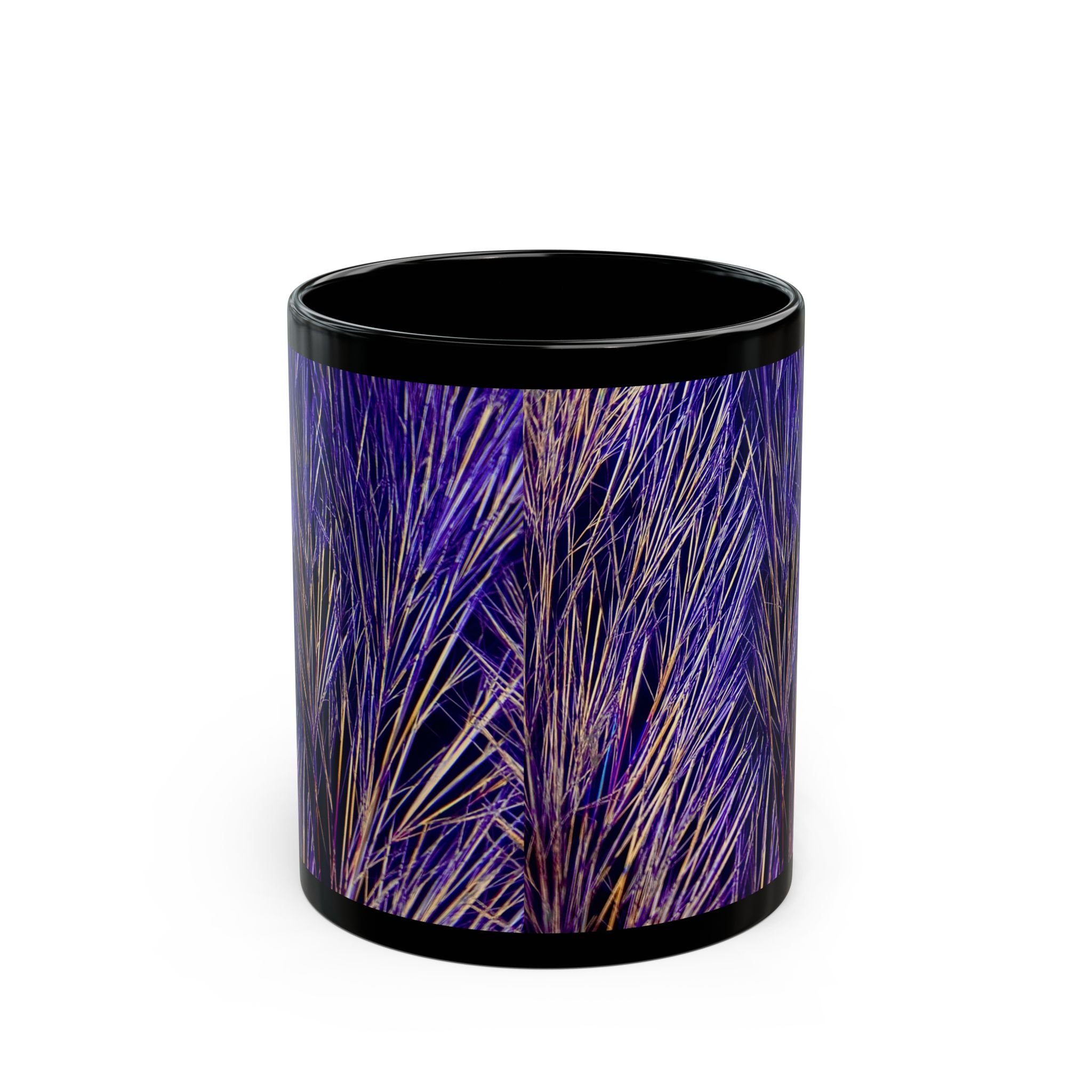 Image 4 of 9
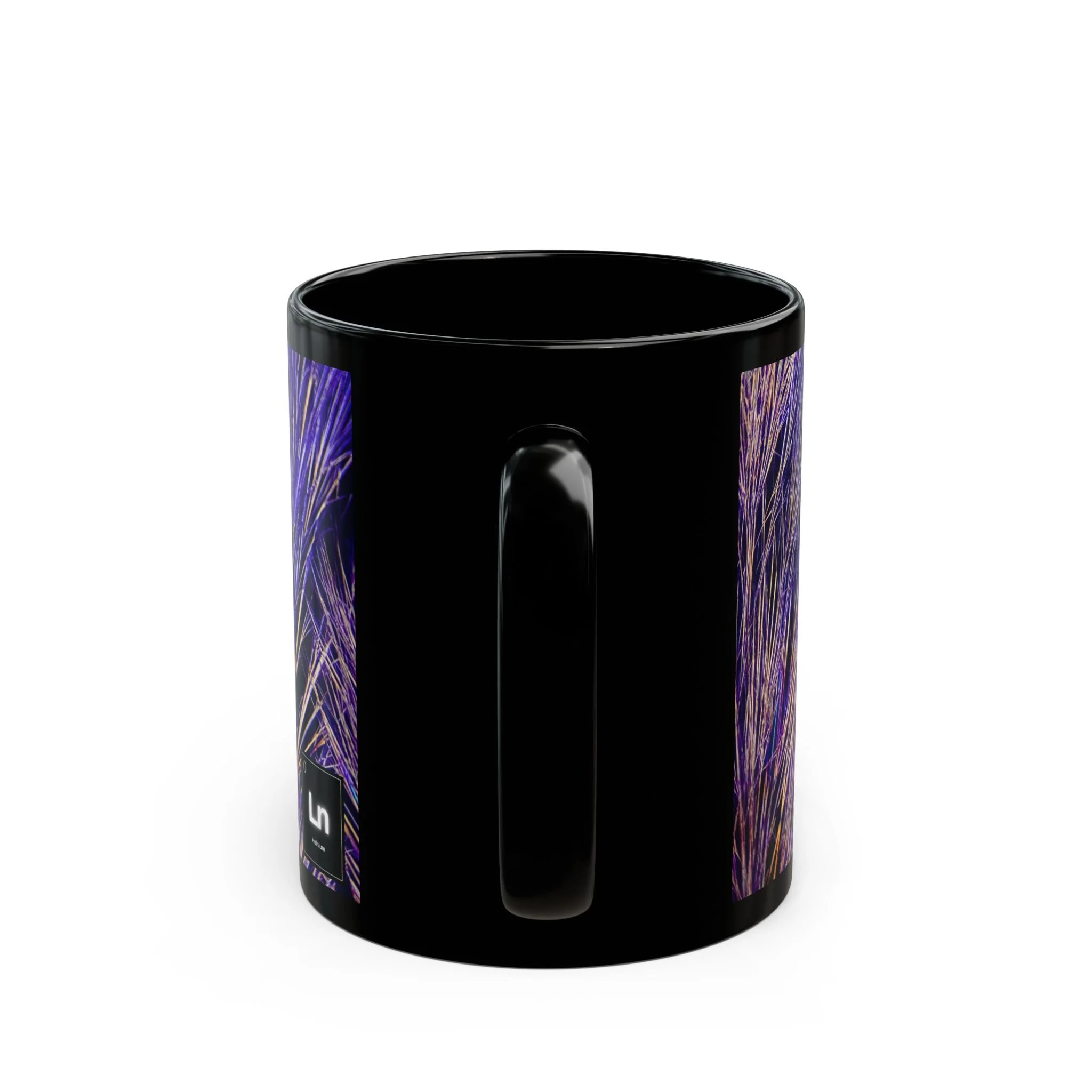 Image 5 of 9
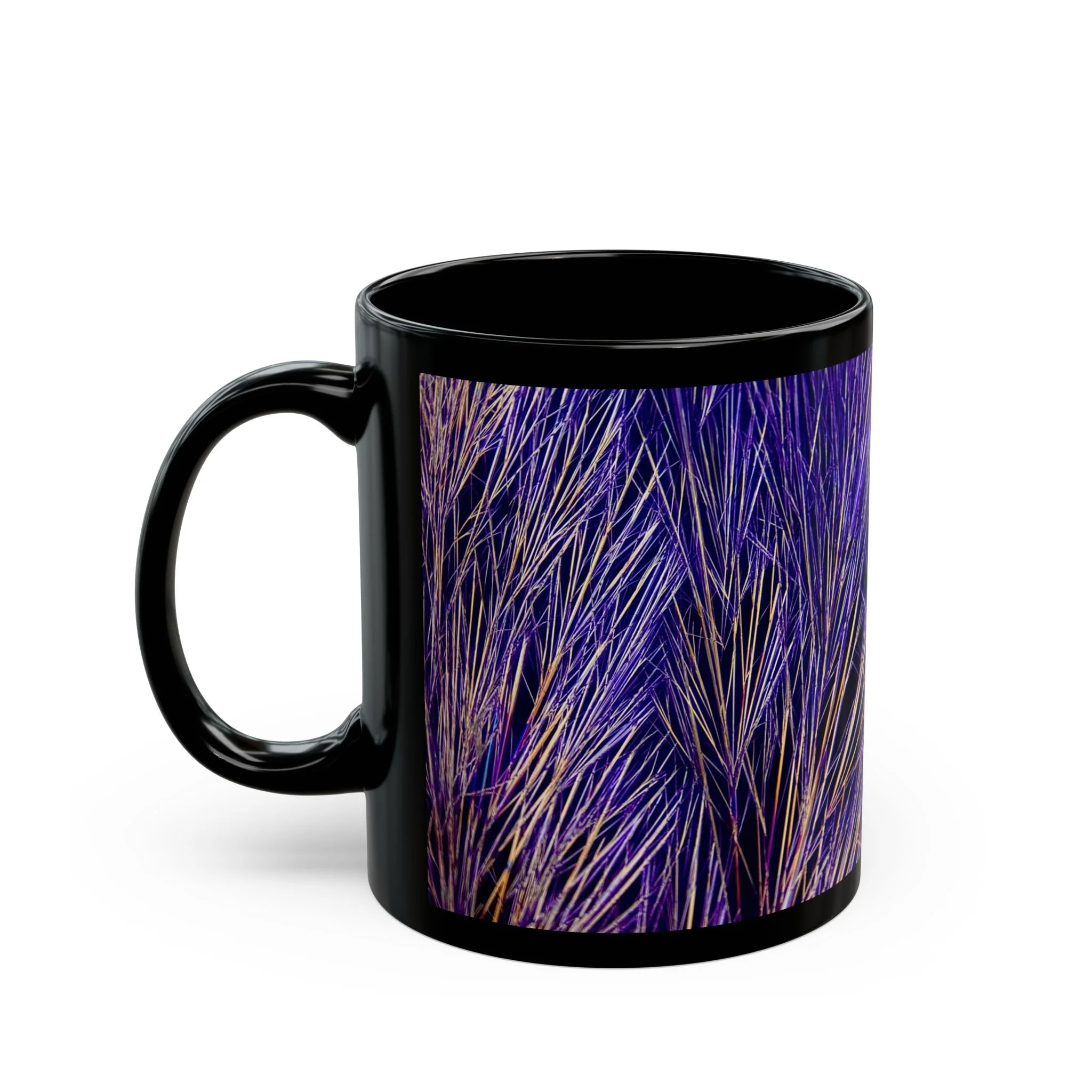 Image 6 of 9
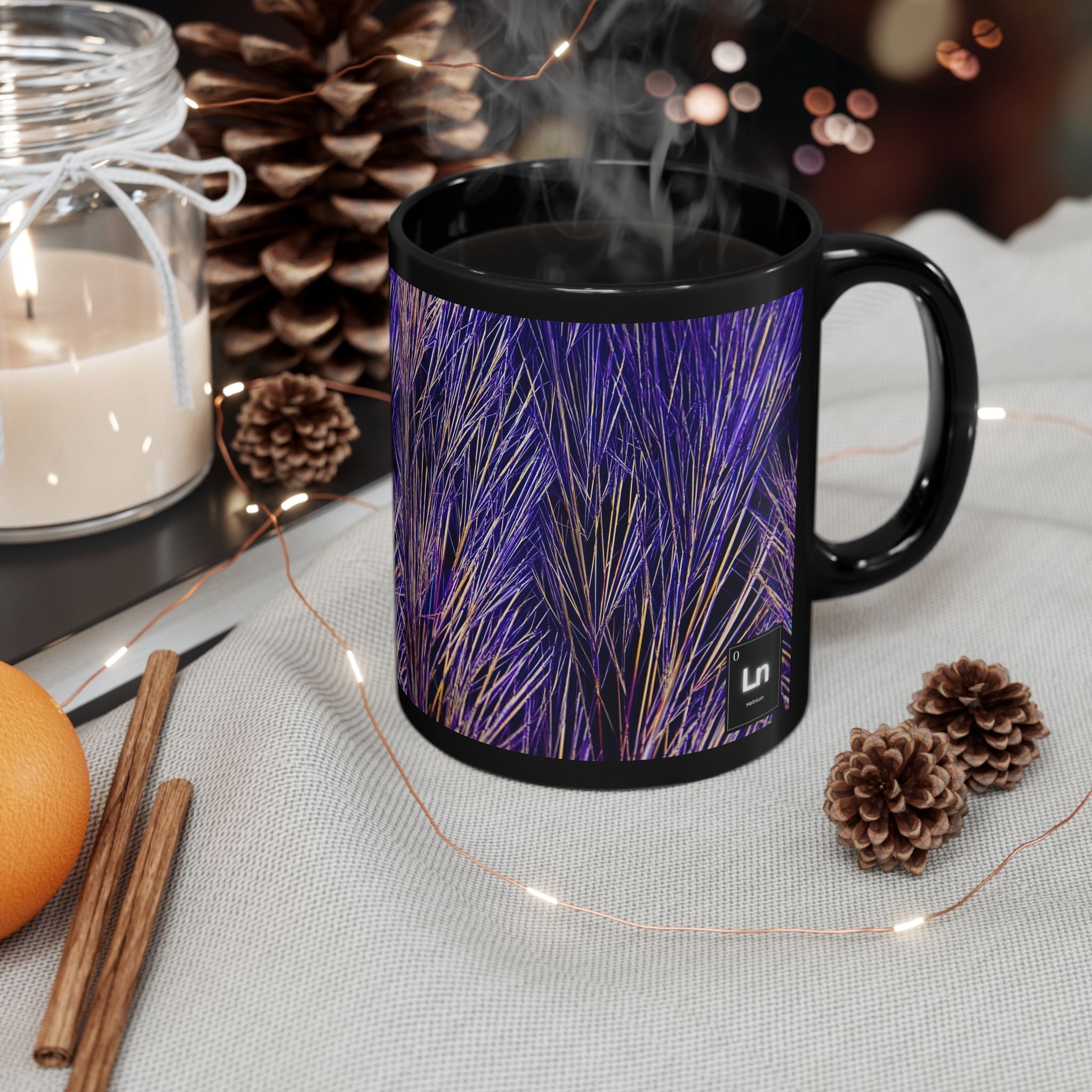 Image 7 of 9
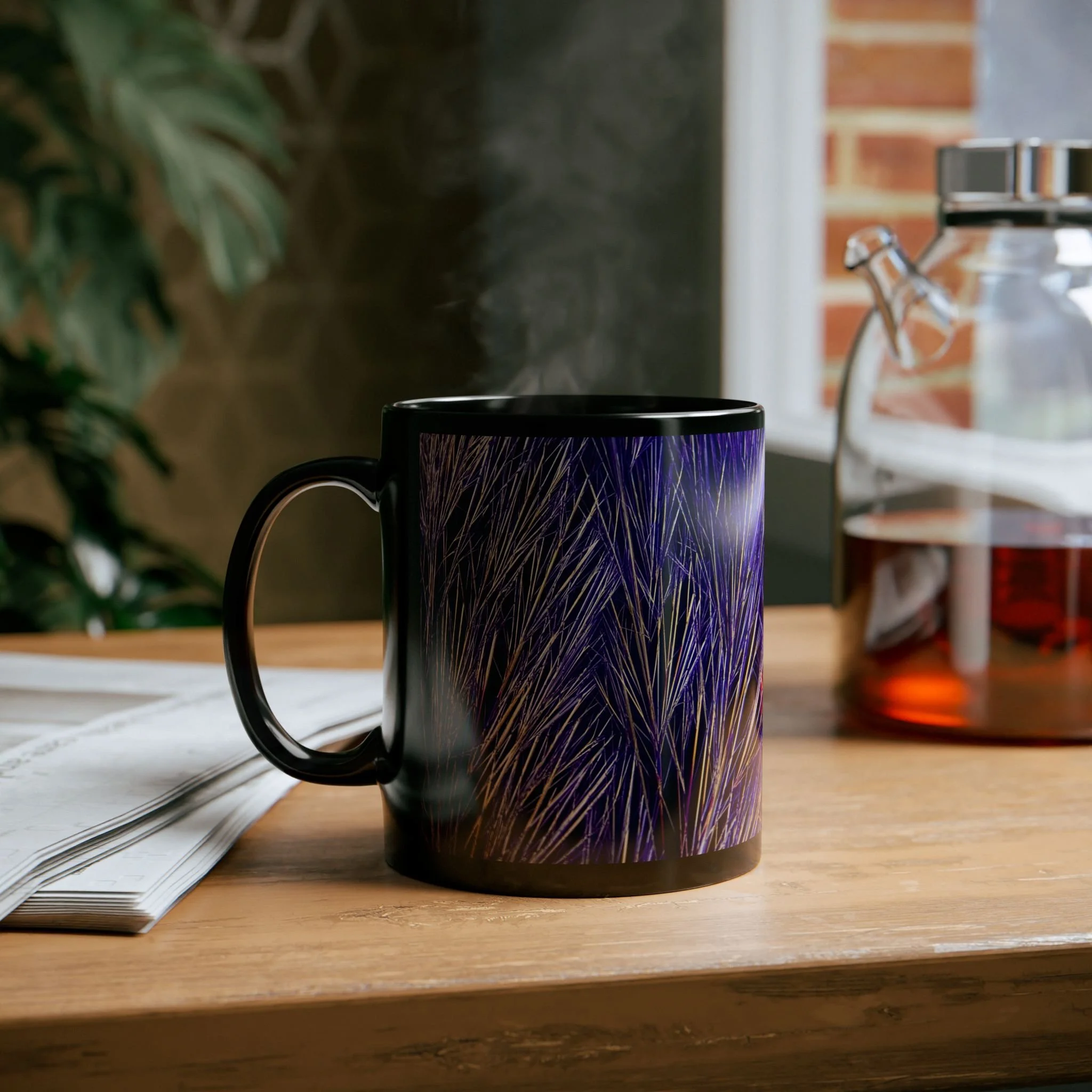 Image 8 of 9
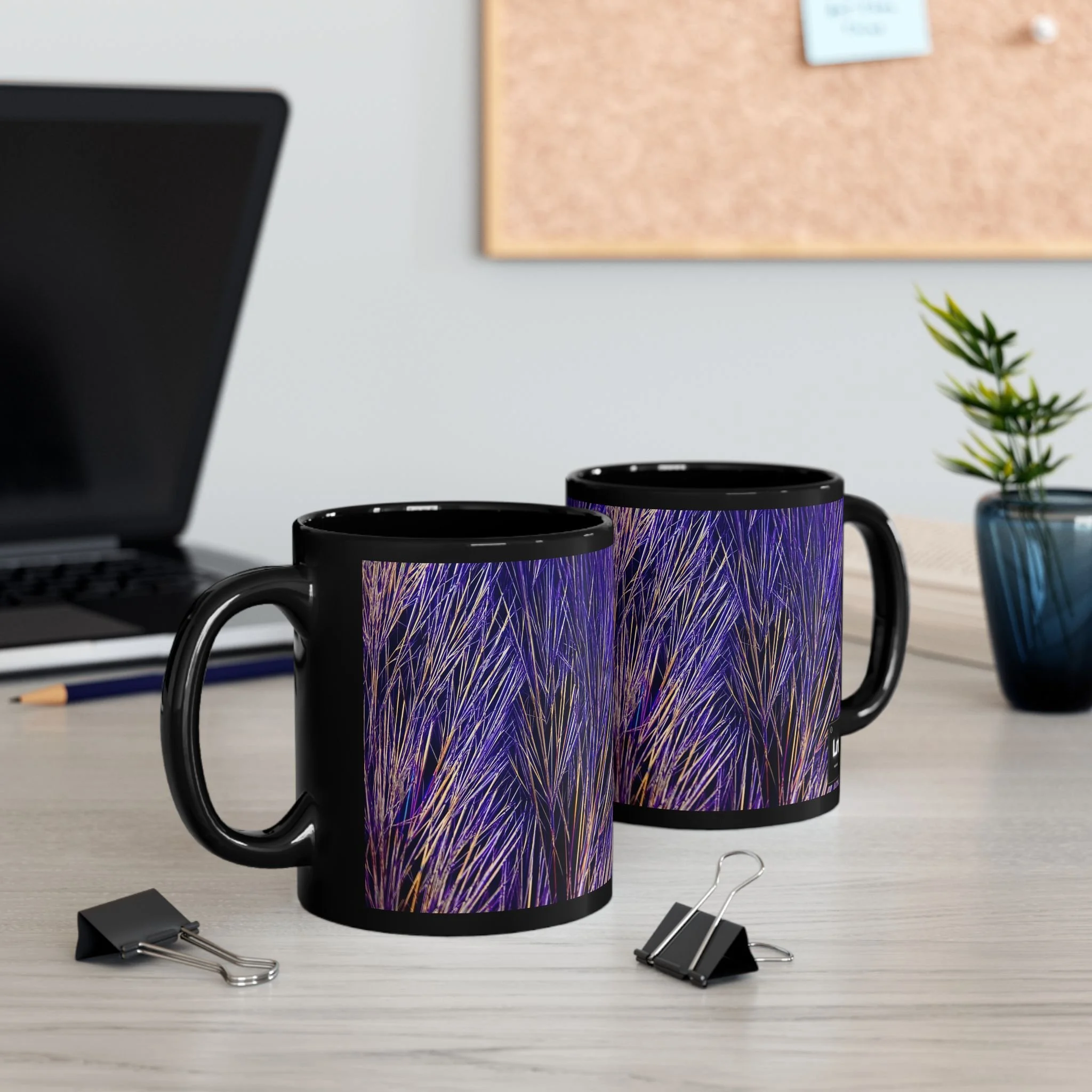 Image 9 of 9